
Being a Woman of Color with Autoimmune Disease: The Mental Health Side That's Often Overlooked


For the last month I've been battling one of the most painful and impairing autoimmune (lupus) flare ups since my diagnosis 12 years ago. My symptoms had been in remission for a few years and so this really felt like it came out of nowhere. However, the real truth is that it didn't come out of nowhere. As I was talking to my own therapist (yes, I'm a proud therapist, who depends on her own mental health therapy too) about this flare up, she asked me about any early warning signs or anything that seemed to trigger it. I rewound what felt like a movie of the beginning of summer (June 2026) and immediately began to feel shame, self-blame and deep sadness. "I did this to myself."
My therapist (thank God for her) held space, let me talk and cry it out, and perhaps might have been fighting her own tears back -- yes, we've cried together before. She's not my rheumatologist who has specific instructions and treatment plan for my lupus, but she's my mental health therapist, whose job it is to find the mental health impact of whatever I'm going through. And I know this because, well, it's literally my same job too and I too have helped many women women of color navigate the mental health impact of their traumas and autoimmune conditions. But that day, I allowed myself to be in the client seat, with all my vulnerability out in the open, let go of "being strong" (although I'm certain that allowing myself to be vulnerable is strength in action), and allowed another human to witness my pain and suffering. You see, this emotional pain and suffering is the mental health side of autoimmune and chronic illness that's often overlooked.
As as trauma specialist, a lot of my clients have overlapping chronic illnesses such as autoimmune conditions, digestive problems, migraines, diabetes, and more. While there is no single and neat answer as to why women of color with trauma histories have these illnesses, the literature supports that the is a link between people of color and disproportionate rates of autoimmune illness, severity of disease progression and systemic inequities (Chae et al 2019; Gilmore 2024; Mendoza, Bolden, Gaona 2026; Deuchman 2021). In his book, "When the Body Says No," Dr. Gabor Mate provides further insights into how emotion and psychological stress can contribute to chronic illnesses.
I see this time and time again in my practice, fellow chronic illness suffers and also myself. Chronic toxic stress and trauma takes a toll on the body causing inflammation and other illnesses. While the chronic illnesses and symptoms themselves are so difficult to deal with and manage. The mental health symptoms add that much more suffering to an already difficult medical situation.
I remember being at the kidney doctor and him telling me in a very matter of fact way, that I'd likely need a kidney transplant in 10 years. He turned around and started typing on the computer. I started crying and he looked at me and didn't know what to do or say. He looked surprised and I was surprised that he was surprised at my response! At the time, I had a 6-month old baby and all of a sudden a ton of flashforward images of my baby being 10 years old, me being very sick, and having kidney failure was too much to bear. And while I've had a handful of very empathic physicians, I've also had a number of not so empathic physicians who just didn't know how to hold space for the emotional overwhelm that can come with chronic illness. Many are simply not trained in the art form of mental health intervention.
In this post, I'll share some common mental health symptoms, systemic contributions, the self-blame aspect that occurs quite frequently, and an example of self-compassion thoughts and actions from myself as a recent case study from my recent flare up.
Here are some common mental health symptoms that can co-occur with chronic illness:
(please keep in mind that every person, chronic illness and response is unique and some might not apply to you, or your response might not be on this list)
- Sadness and grief about not being healthy or anticipating health decline or even death
- Anxiety about health, finances due to not being able to work, or the impact the illness will have on our and our family's lives
- Anxiety noticing new sensations, pain, or "weird" things that are happening to our body
- Anxiety and panic over what people or employers might be thinking about us
- Fatigue and pain that comes with the illness itself
- Fear and inability to tolerate uncertainty about the present or the future
- Excessive and inappropriate self-blame
More on Depression
Depression can set in and there can be excessive self-blame or guilt for being sick, lack of pleasure due to not being able to do things we used to do, or simply a lack of motivation to do them, negative thoughts about ourselves, our future, or how the illness threatens our identity as "hard, capable workers."
Women of Color
For women of color, it can be especially hard since they are at the intersection or race, class and gender and often the most marginalized. Many of us have had to work twice as hard, overwork and over deliver in our lines of work to simply compete in the job market. Black women and Latinas are often hailed for being "strong and resilient," and while that's true, many have stated that they wished they didn't have to be so strong and resilient. For many, resilience is a back handed compliment as it requires first to go through adversity first. And many women of color, would prefer not to be as resilient; they rather not have to go through the adversity to begin with!
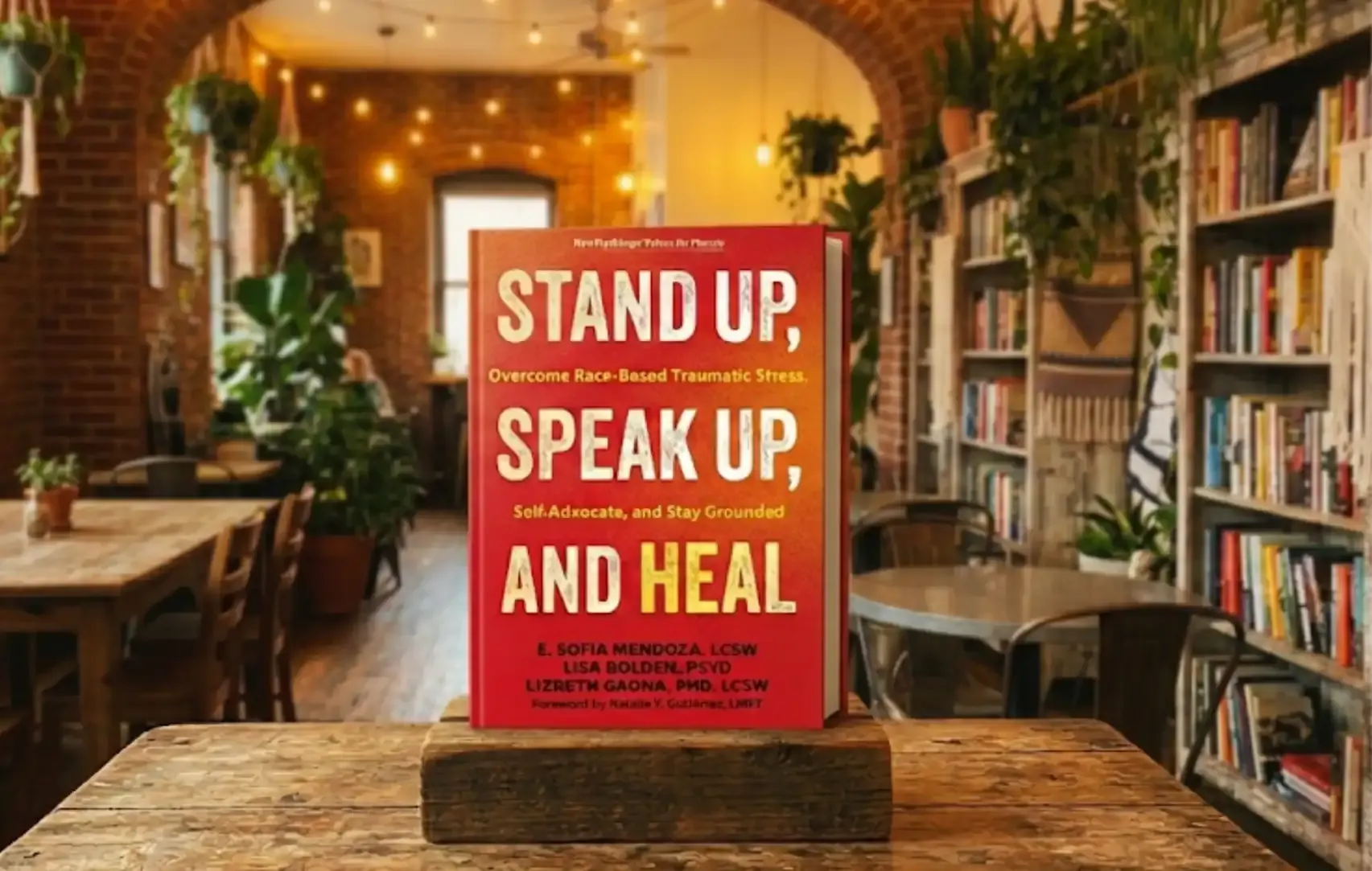
In our book, Stand Up, Speak Up and Heal: Overcome Race Based Traumatic Stress, Self-Advocate and Stay Grounded (2026) my co-authors Dr. Lisa Bolden, Dr. Lizbeth Gaona and I wrote a chapter called, "Racism is making us Sick" where we detail the impact of race-based stress on the body, and how systemic racism, lack of access to services, and food scarcity further contributes to health disparities. The role of generation trauma is often not discussed in medical research either, which offers the perspective of how stress responses and illness gets passed down through our DNA. Simply stating "genetics" as a cause overlooks the historical dehumanization and lack of dignity people of color have faced.
Additionally, other systemic factors such as generational trauma, racial and discrimination stress, and daily reminders of racial injustice contribute greatly to the stress we feel in our bodies. The stress we feel in our bodies are fueled by stress hormones which when produce frequently and in large amounts, can become toxic to the body and organs, which then contribute to illness and disease.
We also make the case for how microaggressions — thinly veiled comments and actions that reinforce stereotypes or negative beliefs — contribute to daily and perpetual stress that builds up.
Self-Blame and "I did this to myself"
"I did this to myself" is something I hear frequently from clients and fellow chronic illness patients.
"I did this to myself" can be justified by:
- "I thought back to all the times I said yes to something even though my mind and body was saying no."
- "I saw myself pushing through exhaustion and didn't consider rest."
- "I knew I wasn't drinking enough water."
- "I didn't schedule labwork or follow up with my rheumatologist.
- "I went for a few walks in the blistering sun, knowing but forgetting that the sun and heat are major triggers for autoimmune flare ups.
- "I haven't been keeping up with my autoimmune diet."
(some or all of these may be mine)
Redistributing blame & how the system contributes:
In therapy, I frequently bring in the concept of the "blameberry pie"* (Shelby, J 2011) where we first create a pie of all the factors responsible for an event occurring. While everyone's blameberry pie is different, the one constant is that most people assign the majority of the blame to themselves. Together, we start to take the blame apart, analyze the situation more carefully, brainstorm all possible factors that we are aware of, and giving a percentage to factors we are not fully aware of, such as biology, invisible factors and more. We do this together and I bring in education and a perspective that centers history, research, science, and many other factors. I use literature that address the impact of racism, stress, trauma, colonization, environmental factors, White supremacy, patriarchy, capitalism, and health disparities for BIPOC. I also remind clients (and myself) that there is so much the we, and the medical community included, DON'T KNOW about autoimmune diseases. It's not a perfect science with treatment certainty. And because of all this, how fair is it to take on a large part of the responsibility or "Blameberry Pie?" We have to keep asking ourselves, "how much of what I'm carrying is actually mine and what can I let go of?"
Thoughts I had to let go of (and re-let go of when they returned):
"I'm going to disappoint others if I say no." There are certain people in my life that it's just so hard for me to say no to. I've had to learn to tolerate knowing that I will indeed disappoint others. I've come to accept that disappointment is a natural human emotion and people get to feel disappointed when disappointment happens. As human beings, we will disappoint others. And in fact, I urge you to. Mainly because it means that you are setting limits, you are saying no, you are saying you're at capacity. It will disappoint others and that's ok. Guess what? You will also be disappointed. Why? Because it's a natural and normal human emotion. The key will be to learn how to cope with your disappointment. Everyone has to figure out how to manage and deal with challenging emotions.
"They're going to know something is wrong with me with my slow responses and brain fog." The truth is when brain fogs hits, it hits and something is wrong. My mind goes blank, I forget words or my train of thought, and a general slowness in my processing. I had to learn to let go of the what if and actually just accept that my brain fog is apparent and in the room. I decided to just name it. I said things like, "sorry, it's coming. I can't find the words right now." "Hey, I just want to let you know ahead of time that I'm actually not feeling very well today and am experiencing brain fog. You might notice be be a little slower, asking you to repeat what you said. Thank you so much for your grace and patience with me today. I appreciate you all." I didn't apologize because I didn't willingly do anything wrong. Saying "thank for your patience and grace" has
These are the self-compassion thoughts that carried me during my flare up:
- I know it hurts right now, I'm so sorry you're here again and right now
- I know you're scared and having thoughts about this all means about your health and future. Just breathe right now. Let's breathe through the pain.
- Rest is resistance. Rest is Recovery. Rest is Replenishment. Rest is Safety right now.
- Rest is right now.
- Rest, sweet girl. (me talking to my younger self who also used to be sick a lot)
- Rest, hermosa.
- Rest, chingona.
- Rest, cabrona. (this one gave me the much needed internal laugh I so needed)
- Being vulnerable is strength in action.
- Give yourself permission to slow down.
In therapy, I help my clients come up with their own self-compassion phrases that will help carry them through the hard times of an autoimmune flare up. The most important part of creating these self-compassion phrases
Self-Compassion Actions I took as I was comforting myself and recovering:
Because in my practice, self-compassion thoughts are important, but not complete without acting nice to yourself. Here are some things I did as I was recovering.
- Drank a lot of water
- Took a lot of naps and prioritized sleep
- Told people I was having a flare up
- Made plans to start my day late
- Asked for deadline extensions
- Took time off work
- Intentionally moved slowly
- I went to pilates but told my instructor I was in an active flare up and would be taking it easy and asking for modifications
- Kept meals simple (protein, fiber, carbs)
- Asked for help with parenting responsibilities
- Asked for help from my 12 year old with age appropriate chores and assistance
- Rescheduled non-urgent tasks/plans
- Used my rolling cart to carry my work bag
- I also watched a lot of Netflix when I was not sleeping. This helped bring a little joy into my flare up days.
In sessions with clients, I encourage them to break down big tasks, simplify systems and to-dos, delegate, set limits, and ask for help. It's all an important part of the recovery process. The key here is to make life as easy as possible on your hardest days.
(while this was a part of my own self-compassion plan, it should not replace the advice of your provider or treatment team).
Conclusion
This might have been a lot to read and digest, especially if you identify as a woman of color with an autoimmune illness. I get it. It's a process coming to terms and understanding these autoimmune conditions when there isn't a whole lot of information, the diagnosis is new or your symptoms are constantly changing — or staying the same. I'd been wanting to write about it for some time now, but it wasn't something I was ready to publicly talk about. But I'm ready now. Especially after having done so much research on health disparities for people of color, living it and seeing it in many clients.
If you identify with anything discussed in this article, I encourage you to get some support. That support can come in many different forms such as, individual therapy, support groups, joining an autoimmune community, discussing with your providers the mental health impact of your illness, speaking with you human resources about job protection and sick leave, etc.
Most importantly, I hope you know that you matter and your sadness and worry about your health makes sense.
References:
Chae DH, Martz CD, Fuller-Rowell TE, Spears EC, Smith TTG, Hunter EA, Drenkard C, Lim SS. Racial Discrimination, Disease Activity, and Organ Damage: The Black Women's Experiences Living With Lupus (BeWELL) Study. Am J Epidemiol. 2019 Aug 1;188(8):1434-1443. doi: 10.1093/aje/kwz105. PMID: 31062841; PMCID: PMC6670046. https://pmc.ncbi.nlm.nih.gov/articles/PMC6670046
Gilmore, H 2024 https://atlantatribune.com/2024/07/16/silent-rage-is-a-hidden-health-crisis-among-women-of-color-fueling-autoimmune-disorders/
Deuchman, J 2021 https://keck.usc.edu/news/health-disparities-and-inequities-impact-black-and-latino-americans-with-autoimmune-diseases-says-new-usc-study/
Mate, G. 2019. When the Body Says No: The Hidden Cost of Stress. https://amzn.to/3UPORHd
Mendoza, E.S, Bolden, L., Gaona, L. (2026) Stand Up, Speak Up and Heal: Overcome Race Based Traumatic Stress, Self-Advocate and Stay Grounded. New Harbinger Publications
*Shelby, J. 2011. I first heard the term "Blameberry Pie" in 2011 by Dr. Janine Shelby, child trauma specialist and psychotherapist who I trained under at the Harbor UCLA Child and Adolescent Psychiatry Trauma Clinic.
I am a participant in the Amazon Services LLC Associates Program, an affiliate advertising program designed to provide a means for me to earn fees by linking to Amazon.com and affiliated sites. You should also know that I stand by my recommendations as I read or use everything I recommend. The fees earned from Amazon.com go toward purchasing more books and materials used in my practice.